Monday, November 13th, 2023
If you are looking for the best Virginia personal injury attorney for your case involving a trucking accident with a tractor trailer, the following five important considerations should be made:
1. Find an experienced Virginia trucking attorney who is also a licensed (CDL) truck driver. As you might imagine, there are very few.
Why is this so important?
Tractor trailers are extremely different than other motor vehicles. A typical car may weigh a couple thousand pounds and be 12’ long. A tractor trailer, on the other hand, weighs approximately 35,000 pounds empty and up to 80,000 pounds when fully loaded.
Your average car receives a yearly inspection – whereas a tractor trailer must be given a thorough pre-trip inspection every day. [1] These inspections are designed to prevent mechanical failure which can lead to catastrophic injuries and death.
A small passenger vehicle, or even a SUV, is no match for a fully loaded tractor trailer during a collision.
A Virginia personal injury attorney who is also licensed as a CDL truck driver has an in-depth understanding of not only the operation of the truck, but also the crucial pre-trip inspection – including knowing how to identify all of the key parts of a tractor and trailer ranging from the complex air brake system to the coupling devices between the tractor and the trailer.
Operation of a tractor trailer is in no way similar to operation of a standard passenger vehicle. A tractor trailer combination is approximately 70’ in length and 8’-9’ wide. Operating such massive vehicles requires special training and experience. When a collision occurs between a passenger vehicle and a tractor trailer, you want an attorney who understands and has experience with actually operating a tractor trailer and a passenger vehicle and has had experience investigating catastrophic collisions involving these vehicles.
At some point in any lawsuit against a trucking company, there will come a day when your Virginia personal injury attorney must depose (question) the truck driver and, perhaps, representatives of the trucking company. The deposition goes much different when the attorney is also a truck driver and speaks “the language” of the trucking industry.
2. Tractor trailer accident law is complex. It is imperative that you hire someone who understands the complexities of both federal and state law as it applies to tractor trailers.
If a crash occurs in Virginia, two bodies of law apply. First, the Federal Motor Carrier Safety Administration (FMCSA) regulates “all employers, employees, commercial motor vehicles and transport property or passengers interstate commerce.” [2]
A commercial motor vehicle includes any vehicle weighing 10,100 pounds or more. [3] The Code of Regulations defines interstate commerce as “trade, traffic or transportation in the United States – (1) between a place in a state and a place outside such state . . . ; (2) between two places in a state through another state or a place outside of the United States; or (3) between two places in a state as part of trade, traffic or transportation originating or terminating outside of the United States.” [4]
Although the FMCSA rules technically do not apply to commercial vehicles operating only within a single state (Virginia) and involving solely intrastate commerce, the Virginia Administrative Code incorporates the FMCSA rules by reference with a few slight modifications. [5] Therefore, the FMCSA rules apply to a commercial motor vehicle operating in interstate or intrastate commerce within or through the Commonwealth of Virginia.
In other words, one way or another the complex Code of Federal Regulation will have an impact on any tractor trailer crash in Virginia. Knowledge of these rules is imperative to a successful outcome.
3. It is crucial that a victim or his or her family locate an attorney/lawyer in a firm with sufficient size and resources to litigate against a large trucking company.
A tractor trailer company has the advantage in almost every aspect of a crash. First, the tractor trailer driver has likely received extensive training in what to do after a crash occurs. Within minutes, a telephone call will be made to dispatch which will then send out a “quick response” team of investigators, accident reconstructionist, insurance adjusters, and perhaps even attorneys. It is rare that any representative of the occupants of a passenger vehicle know enough to immediately summon the help of an experienced trucking lawyer. If such a contact is made, it is imperative that it is made to a firm with sufficient resources to immediately dispatch a quick response team who can:
- Go to the scene of the crash;
- Involve an experienced truck accident reconstructionist;
- Preserve the evidence of the scene, vehicles, ;
- Conduct inspections of the truck, trailer and any other vehicles involved; and
- Send out a “preservation” letter to all of the potential defendants to make sure that no evidence is destroyed, altered or lost.
In other words, retaining the right attorney, with the right sized firm, will even the playing field between the trucking company and the victims or occupants of the other vehicles. The longer it takes for the victims to engage an attorney, the more risk there is that valuable evidence will be lost.
4. Hire an attorney/firm with extensive federal court experience.
Most tractor trailer accidents on a Virginia highway end up in federal court.
Cases between individuals who are residents of Virginia often litigate their claims in state court. Truck accidents often involve foreign corporations and out-of-state drivers. Consequently, there is very often “diversity” between the litigants. When this occurs, the case can be brought in federal court or removed there by the defendant even if a plaintiff files in state court. This can happen very quickly and the rules in federal court are much more strenuous and exacting than one would experience in state court.
Law firms like Gentry Locke have multiple attorneys who have extensive experience in federal court – including having clerked in federal courts at some point in their career. Knowing how to navigate the federal court system is as important as knowing how to operate a tractor trailer.
5. Hire an attorney/lawyer who is willing to let you interview a “real” past or present client who was involved in a complex tractor trailer crash.
There is a tremendous amount of knowledge to be gained by speaking with someone who had endured a lawsuit against a large corporation, such as a trucking company.
At Gentry Locke, we commonly connect our clients who have similar experiences and injuries. We have found this to be tremendously helpful to everyone in navigating what seem like an insurmountable mountain.
We also encourage our truck accident clients to reach out to the Truck Safety Coalition, which is literally composed of the prior victims of truck crashes and who are united to help guide the trucking industry toward safer rules and regulations.
Summary
Truck drivers are like any other profession. The vast majority of them are extremely professional, courteous and follow the rules and regulations of both federal and state law. However, it only takes one rogue truck driver or trucking company to destroy a family and/or its wage earner in an instant. Selecting the right attorney, in the right firm, and with the right resources will have a huge impact on the case. If you need a personal injury attorney, contact us.
[1] 49 C.F.R. § 396.13
[2] 49 C.F.R. § 390.3(a)
[3] 49 C.F.R. § 390.5.
[4] 49 C.F.R. § 390.5.
[5] See 49 C.F.R. § 390.3(a); see also 19VAC30-20-40
Wednesday, November 8th, 2023
The Federal Trade Commission (FTC) announced on October 27th that it has expanded the scope of its financial data security rule, which will now require nonbank financial institutions – like vehicle dealers and mortgage brokers – to report data breaches. This new amendment to the FTC Safeguards Rule imposes similar reporting requirements to those already applicable to banks.
Specifically, the amendment will require nonbank financial institutions to report to the FTC any data breach affecting 500 or more consumers’ data. The rule gives financial institutions 30 days to report the breach, however the FTC encourages reporting as soon as possible. Importantly, the reporting requirement applies only to breaches of unencrypted data, underscoring the importance of implementing sound cybersecurity protocols like end-to-end encryption of data.
In his statement announcing the amended rules, Samuel Levine, the director of the FTC’s Bureau of Consumer Protection, emphasized the importance of corporate transparency and rapid disclosure of incidents, even before the 30 day timeline when possible. The new requirements will take effect in approximately six months, according to the FTC.
This new reporting requirement places a significant new burden on affected financial institutions, as reporting an incident to the FTC will trigger an investigation into the company’s cybersecurity practices and compliance with the Safeguards Rule. Failure to report an incident will put the offending company into the far more precarious position of being the subject of not only an FTC investigation, but also an enforcement action accompanied by hefty fines and the potential for criminal penalties.
In light of the massive financial and reputational risk posed by increasingly active threat actors and the government’s corresponding regulation of corporate cybersecurity, it has never been more important for companies to develop and implement robust cybersecurity and data privacy policies. It is equally crucial to consult with experienced legal counsel for assistance developing these proactive policies and, when necessary, responding to cyber incidents.
If you have any questions about this update, please reach out to John Danyluk at danyluk@gentrylocke.com.
Wednesday, November 8th, 2023
Article originally published by Bloomberg Law: AI Standing Orders Proliferate as Federal Courts Forge Own Paths (bloomberglaw.com)
Reproduced with permission. Published Nov. 8, 2023. Copyright 2023 Bloomberg Industry Group 800-372-1033. For further use please visit https://www.bloombergindustry.com/copyright-and-usage-guidelines-copyright
Gentry Locke’s Jessiah Hulle surveys federal courts’ ever-expanding guidance on artificial intelligence, and finds that, for now, courts are experimenting with varied approaches to the new technology.
Federal courts nationwide are weighing in on how artificial intelligence can be used in court filings, and they’re exploring different approaches to address issues such as disclosure, accuracy, and ethical duties.
A comprehensive review of 196 federal court websites reveals that judges continue to release AI orders at a steady pace. So far, at least 14 federal courts have released official guidance on using AI tools in litigation.
These new orders also reveal a notable trend: Most courts personalize AI mandates rather than adopt guidelines verbatim from colleagues.
AI’s Perils Inspire Policies
Judicial scrutiny of AI tools intensified in May, when a lawyer in Mata v. Avianca, Inc. filed a brief citing “nonexistent cases” created by ChatGPT, a generative AI software. The lawyer, who admitted relying on ChatGPT rather than personally verifying the cases, was later sanctioned by a federal judge.
Shortly after Mata, Judge Brantley Starr of the US District Court for the Northern District of Texas issued the first judicial standing order on AI. The order requires litigants in his court to file a certificate attesting either that no generative AI will be used in filings or that any generative AI use will be “checked for accuracy … by a human being.” Starr says the certificate is necessary because generative AI is “prone to hallucinations and bias.”
Others quickly followed suit. Orders by three judges—Judge Stephen Vaden of the Court of International Trade, Magistrate Judge Gabriel Fuentes of the Northern District of Illinois, and Senior District Judge Michael Baylson of the Eastern District of Pennsylvania—received national attention. Each judge put their own spin on Starr’s prototype.
Vaden’s standing order focuses on confidentiality, requiring litigants to expressly disclose use of generative AI and file a certificate attesting that such use didn’t disclose proprietary information to unauthorized parties.
Fuentes’ order also requires litigants to disclose the use of generative AI, but has no certificate requirement. Instead, to safeguard accuracy, Fuentes relies on Fed. R. Civ. P. 11, which requires arguments in a filing to be “warranted by existing law” and provides sanctions for noncompliance.
Baylson’s standing order is the most unusual of these four pioneers. It mandates disclosure of any use of AI—generative or not—and requires litigants using AI to certify that citations in a filing are “verified as accurate.” Two former federal judges note that Baylson’s order, by its broad terms, “directs counsel to reveal the use of seemingly innocuous programs like Grammarly.”
Practitioners predicted that other federal judges would follow the lead of these high-profile orders. Months later, those predictions have proven correct.
AI Orders Proliferate
Federal courts are steadily releasing AI standing orders, and—so far—no template has emerged.
For example, it appears that only three district judges—Judge Leslie Kobayashi of the District of Hawaii, Judge Scott Palk of the Western District of Oklahoma, and Judge Gene Pratter of the Eastern District of Pennsylvania—have issued orders mirroring Starr’s prototype.
In comparison, the Western District of Oklahoma Bankruptcy Court has an AI standing order adopting the substance of Starr’s order, but adding Vaden’s requirement that generative AI users certify nondisclosure of confidential information.
Likewise, New Jersey District Judge Evelyn Padin’s standing order generally tracks Starr’s model, but adds a condition that the certification must identify the specific “portion of the filing” drafted with generative AI.
Only one jurist, Magistrate Judge Jeffrey Cole in the Northern District of Illinois, has copied Baylson’s order regulating all AI. Cole requires certification even if AI is used for research rather than drafting. This restriction potentially encompasses everything from ChatGPT to AI-assisted search engines and chatbots.
In contrast, orders issued by the Northern District of Texas Bankruptcy Court and Southern District of New York Judge Arun Subramanian simply warn litigants about generative AI pitfalls without demanding disclosure or certification. Both orders, like Fuentes’, rely on federal procedural rules to certify trustworthy filings.
Moreover, at least two courts expressly prohibit use of AI.
The Eastern District of Missouri provides guidance on its website titled “Self-Represented Litigants” that prohibits filings drafted by generative AI.
Similarly, Judge Michael Newman of the Southern District of Ohio has a standing order prohibiting litigants from using AI in preparing filings. But importantly, Newman carves out an exception for AI in legal and internet search engines. He also requires litigants to inform the court if they discover that AI was used in creating a filing.
Check Local Rules
This varied proliferation of federal standing orders means that judicial curtailment or moderation of AI use in litigation is ongoing, not a passing trend. Pratter, for instance, published her AI order in October. And state and foreign courts are joining the bandwagon.
As this landscape is constantly changing, lawyers and pro se litigants should therefore always double-check local rules and individual judge preferences before using AI in a court filing.
This article does not necessarily reflect the opinion of Bloomberg Industry Group, Inc., the publisher of Bloomberg Law and Bloomberg Tax, or its owners.
Monday, November 6th, 2023
The Securities and Exchange Commission (SEC) announced charges against SolarWinds Corp. and its chief information security officer (CISO), accusing the publicly traded company of misleading investors as to its vulnerability to cyberattacks. SolarWinds is accused of defrauding investors by overstating its cybersecurity practices, while failing to implement appropriate internal digital safeguards and ignoring red flags for years before announcing that it was the victim of a two-year long cyber attack in December 2020.
This landmark lawsuit represents the first time in an SEC cyber case that the commission has alleged that an organization intended to deceive investors. Perhaps even more alarming for information security executives performing an increasingly difficult corporate function, it is the first time in an SEC cyber case that the commission has brought action against an individual.
The SEC alleged that SolarWinds and CISO Timothy Brown, who is individually named in the lawsuit, knew as early as 2018 that software it sold to the federal government was, in the words of one company engineer quoted in the complaint, “not very secure.” According to the complaint, SolarWinds’ poor security practices were not a secret within the company, prompting several employees to express their concerns.
According to the director of the SEC’s enforcement division, “[r]ather than address these vulnerabilities, SolarWinds and Brown engaged in a campaign to paint a false picture of the company’s cyber controls environment, thereby depriving investors of accurate material information.”
The SEC’s complaint, filed in the Southern District of New York, alleges that SolarWinds and Brown violated the antifraud provisions of the Securities Act of 1933 and of the Securities Exchange Act of 1934; SolarWinds violated reporting and internal controls provisions of the Exchange Act; and Brown aided and abetted the company’s violations. The complaint seeks permanent injunctive relief, disgorgement with prejudgment interest, civil penalties, and an officer and director bar against Brown.
The SEC’s aggressive enforcement of the massive SolarWinds breach reflects the tremendous impact that a breach can have to a company’s value and stock prices. Further, by placing the company’s CISO squarely in the SEC’s crosshairs, CISOs and other cyber executives are now on notice that they may be held personally responsible for security and disclosure failures. On the heels of the criminal sentencing of former Uber CSO, Joseph Sullivan, for his role in the company’s 2016 data breach, these executives are predicted to become increasingly risk-averse and choose self-preservation over corporate profits by proactively report vulnerabilities and breaches. The government’s willingness to go after individual employees means that those employees have even greater motivation to become whistleblowers and report perceived cybersecurity failures within the company, thereby protecting themselves while potentially securing a sizable relator settlement under the False Claims Act.
If you have any questions concerning your company’s cybersecurity, please reach out to John Danyluk at danyluk@gentrylocke.com.
Monday, October 23rd, 2023
A favorable and unanimous opinion released on October 19, 2023 in the case of Ashley Nicole Noonan v. Consolidated Shoe Company, Inc. by the United States Court of Appeals for the Fourth Circuit, upheld a win for Gentry Locke’s client, Consolidated Shoe Company, Inc. The Plaintiff brought gender discrimination, Equal Pay Act, and retaliation claims against our client. Cate Jackson argued the case in the Western District of Virginia Court with assistance from Paul Klockenbrink and Amanda Morgan. Judge Moon granted summary judgment in Consolidated Shoe’s favor in November 2021. The Plaintiff appealed and the appeal was argued in January 2023 and was successfully handled by the head of Gentry Locke’s Appeals and Critical Issues practice, Monica T. Monday.
Read more about this case in this article published by Law360 here.
Friday, September 15th, 2023
On March 9, 2023, Virginia Governor Glenn Younkin signed into law legislation (SB1213/HB2180) that directed the Department of Professional and Occupational Regulation (DPOR) to create Universal Licensing Recognition (ULR) for 85 occupations, including construction trades.
ULR applies to all individual licenses regulated by DPOR, except architects, engineers, land surveyors, and landscape architects. ULR does not apply to contractor licenses.
ULR does not mean that Virginia will automatically recognize an out of state individual’s license. The out of state individual must apply for a Virginia license before the person commences work in Virginia.
DPOR boards will grant licenses to out-of-state applicants who possess a license issued by another state, if:
- The applicant has held an equivalent license in another state for at least three years;
- The applicant is in good standing in all states where they were/are licensed;
- The applicant was required to pass a competency exam to obtain their original state license;
- The applicant met training standards to obtain their original state license; and
- The applicant pays all applicable Virginia licensing fees.
The new law took effect on July 1, 2023 and the DPOR has implemented new ULR procedures.
Friday, September 15th, 2023
VDOT will be holding a design public hearing on September 19 from 5 p.m. to 7 p.m. at Lord Botetourt High School (located at 1435 Roanoke Road, Daleville), on an upcoming project to widen I-81 from two to three lanes in both directions along a seven-mile stretch between Exit 143 in Roanoke County and Exit 150 in Botetourt County. The hearing will be an open house format, and VDOT representatives will be present to answer questions.
The project is expected to include:
- The replacement of eight bridges on I-81
- The installation of approximately 8,500 feet of sound barrier along the northbound lanes
- The realignment of two ramps and removal of one ramp at exit 150
- A change and/or break in limited access
This expansion from two to three lanes along this stretch is expected to expand the capacity of this corridor and reduce crashes. More information about the project can be found at virginiadot.org/I81exit143to150.
Comments about the project may be submitted at the hearing, or until September 29, 2023 to Craig Moore, Project Manager, 731 Harrison Avenue, Salem VA 24153. Comments may also be emailed to I81-Exit143-150@vdot.virginia.gov, with the reference “I-81 Exits 143 to 150 Widening Public Comment” in the subject heading. Anyone requiring special assistance to attend and participate in this meeting can contact Craig Moore at 540-387-5353, 800-367-7623, TTY/TDD 711.
This project is part of the ongoing 10+ year plan to improve Interstate 81 under the $2 billion I-81 Corridor Improvement Program signed into law in 2019. Additional information about the I-81 Corridor Improvement Program is available at Improve81.org.
Learn more about the Interstate 81 Developments, Impacts, and Updates here.
Monday, September 11th, 2023
The Surface Transportation Board (“STB”) issued a Notice of Proposed Rulemaking (“NPRM”) in a new sub docket of Ex Parte 711 (Sub. No. 2), regarding open access a.k.a. competitive switching rules. Comments on the proposal are due October 23, 2023; Reply comments are due November 21, 2023. The summary below provides some high-level points, but the decision is lengthy, highly detailed, and subject to further analysis (particularly with respect to the detailed discussion of performance standards).
This decision closes Docket No. EP 711 (Sub-No. 1) and proposes, in a new subdocket, a new set of regulations that would provide for the prescription of reciprocal switching agreements to address inadequate rail service, as determined using objective standards based on a carrier’s original estimated time of arrival, transit time, and first-mile and last-mile service. To help implement the new regulations, the Board proposes (1) to require Class I carriers to submit certain data, which would be publicly accessible and generalized; and (2) to adopt a new requirement that, upon written request by a customer, a rail carrier must provide to that customer individualized, machine-readable service data.
Among other issues, the STB specifically requested comments on the following:
- Whether the reciprocal switching tariff of an alternate carrier applicable to shippers in the same area should be considered as evidence, and how to reconcile inconsistencies in railroad tariffs (e.g., instances in which one railroad lists a location as open to reciprocal switching and another railroad does not).
- Whether such prescriptions should include a minimum level of switching service and, if so, whether the Board should establish a separate and specific penalty structure to be imposed on carriers that do not meet that level of service.
- Whether it could require a carrier to disclose data about past service to a shipper or receiver when a different entity paid for the service.
- Whether it should give the entity that paid for the service the opportunity to seek confidential treatment of service data that a carrier provides to a shipper or receiver upon request.
- Which compensation methodologies are appropriate.
- What is the proper performance metric for unit trains.
Related to the railroad affirmative defenses:
- Whether 20% and the 12-week notice period are reasonable, and whether (and, if so, how) the Board should consider any history of the shipper notifying the carrier of surges that did not come to fruition
- Whether, and under what circumstances, the Board has the authority to consider reciprocal switching requests from shippers that have entered into a valid rail transportation contract with the incumbent carrier.
- Whether the Board may consider the performance data described above, based on service that a carrier provided by contract, as the grounds for prescribing a reciprocal switching agreement that would become effective after the contract expired.
- Whether the Board may require a carrier to provide performance metrics to a rail customer during the term of a contract upon that customer’s request.
- When, prior to the expiration of a transportation contract between the shipper and the incumbent carrier, the Board may prescribe a reciprocal switching agreement that would not become effective until after the contract expires.
For further information contact John Scheib at scheib@gentrylocke.com.
Read more in the Notice of Proposed Rulemaking, below:
Monday, August 28th, 2023
By Matthew W. Broughton, Jared A. Tuck, and Summer Associate Joshua R. Justus
It can be easy to ignore the worst case scenario until it actually happens, and when it does, you don’t want to be left wondering what you could have done differently.
 Uninsured motorist coverage (UM) and underinsured motorist coverage (UIM) act like a safety net for you and your family if you are involved in a collision with a motorist who either: doesn’t have any motor vehicle insurance or doesn’t have enough insurance to cover your damages. It is common for survivors and surviving family members of large truck crashes to suffer millions of dollars in medical costs or lost income alone. This financial burden is one that you can take steps to reduce or prevent altogether by reviewing your current uninsured and underinsured motorist coverage and obtaining an umbrella policy.
Prior to July 1, 2023, under Virginia law, your potential UIM payout after a collision with an underinsured motorist would be reduced by the underinsured motorist’s liability coverage.[i] For example—defendant negligently rear-ends Sally on June 15, 2023, causing $100,000 in damages. The defendant only had $50,000 in liability coverage. Sally had $50,000 in uninsured motorist coverage (UM) per her insurance policy. The math:
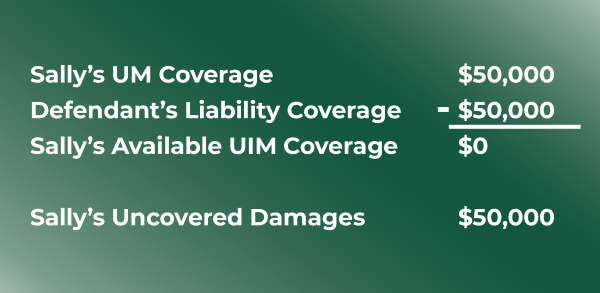
The result is that Sally does not receive any payment for her damages over the defendant’s liability coverage, although she has $100,000 in damages due to the collision. Assuming that the defendant does not have any significant assets, Sally’s recovery would be limited to $50,000 from the defendant’s liability insurer.
Now that the law has changed, your potential payout is not reduced by the underinsured motorist’s liability coverage. For example, if the current law applied in Sally’s scenario above, she would be able to recover compensation for all $100,000 of her damages. She could potentially recover $50,000 in liability coverage from the defendant’s policy and $50,000 in underinsured coverage from her own policy. In other words, you are now able to benefit from your entire underinsured policy limits when the damages from the collision exceed the liability coverage of the other motorist.[ii] However, you must renew your policy after the July 1, 2023 date for this change to take effect. Now is the best time to both renew your policy and consider increasing your coverage, so that you and your family are protected today and into the future.
Umbrella insurance policies are another great way to keep your family safe from crippling financial burdens that may result from a motor vehicle collision. If UIM coverage is your safety net, then an umbrella policy is the giant landing pad under the net if it fails. Given the expensive nature of damages from motor vehicle collisions—especially where there are multiple family members in the car—umbrella coverage is a must have.
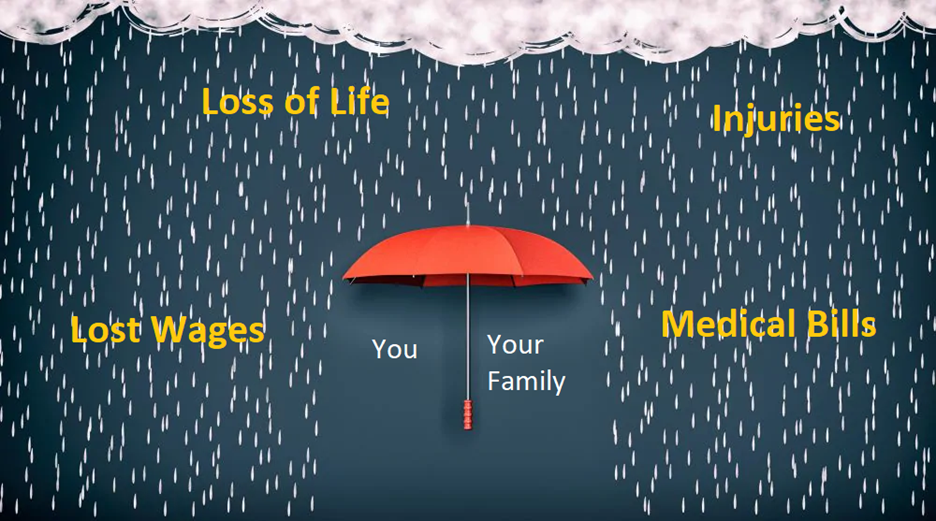
An umbrella insurance policy with uninsured and underinsured motorist coverage will provide additional protection in the event that the damages from the collision exceed your UIM and the negligent motorist’s liability coverage. With this additional policy, you can drive knowing that you, and your family, will get the amount of coverage you need, when you need it.
Next Steps to Protect You & Your Family:
- Contact a qualified insurance agent near where you reside and discuss the available options to meet your needs. Do not use online insurance brokers!
- Renew your UIM insurance policy as early as possible to take advantage of the changes to the law.
- Consider increasing your current UM and UIM coverage.
- Consider adding an umbrella policy with UM and UIM coverage. Many umbrella policies contain only liability coverage. It is important to ask your agent to include UM and UIM coverage as part of the umbrella policy.
- Do not sign any documents asking you to elect or agree to reduce your available UIM coverage by the underinsured motorist’s liability coverage.
[i] Va. Code Ann. § 38.2-2206(B) (effective until July 1, 2023).
[ii] Va. Code Ann. § 38.2-2206(B) (effective July 1, 2023).
Friday, August 25th, 2023
AI tools undoubtedly offer benefits in the recruitment and hiring process; however, the use of AI screening tools when making employment decisions comes with associated risks. One significant risk is that an employer may unintentionally violate federal anti-discrimination laws if the AI tool disproportionately screens out individuals in protected classes and the employer is unable to justify the exclusion as sufficiently job-related and consistent with business necessity. The increasing popularity and use of AI tools in the recruitment and hiring process has caught the attention of the Equal Employment Opportunity Commission (EEOC), and it has begun to aggressively target AI hiring bias, which includes new Technical Assistance issued on May 18, 2023.[1]
Forecasting the importance of this issue, last May the EEOC Chair announced that the agency had filed its first lawsuit against a company, iTutor Group, for hiring discrimination in violation of the Age Discrimination in Employment Act (ADEA).[2] The EEOC alleged that the company’s software program automatically rejected over two hundred job applicants between the ages of 55-60 during a one month period. While the company denied intentional discrimination, on August 9, 2023, the company nevertheless settled the case and agreed to pay $365,000 to the screened out applicants, to send an invitation to each person disqualified to reapply, to adopt changes to its anti-discrimination policies, to provide training to all executives and managers prevent running afoul of federal anti-discrimination laws in the future, and to be subject to EEOC monitoring for five (5) years.[3]
Why is this lawsuit and settlement so important? Within the last year, the EEOC has unequivocally demonstrated that it will seek to hold vendors and employers liable for violating federal nondiscrimination laws as the result of the adverse impact that results from programming decisions built into AI tools, whether the scrutinized feature used was implemented intentionally to discriminate or not. The successful pursuit and settlement of its claims against iTutor, likely means that the EEOC will be emboldened to pursue others in the near future. If a commonly cited SHRM survey (which reportedly states that 79% of employers use some form of AI in the recruitment and hiring process) is accurate, then it is only a matter of time before new suits will be filed. When these suits are filed, and if they involve the use of AI tool that screens out a group of prospective workers (age, sex, national origin, disability, etc.), then employers will not be facing a single claim by one disappointed applicant, but a very costly class action claim.
In this evolving area, it is incumbent on all employers to identify and understand what AI tools are being used, directly or indirectly by a third party, as part of the company’s recruitment and hiring process to determine what steps may need to be taken to minimize the risks of future litigation. The fact the employer does not know that the AI tool is being used or that the program used has a feature that allows the tool to unlawfully screen out a protected category of applicants or employees is not a defense if there is a significantly significant adverse impact caused by the AI tool. As a result, at a minimum employers and human resource managers should make sure that all AI products used and the supporting vendors are carefully vetted to gain a sufficient level of comfort that the AI screening tools have been designed, reviewed, and tested to avoid unintended adverse impacts on protected categories of applicants and employees. If you have questions regarding these issues or need assistance in evaluating. correcting or remediating issues involving the use of AI in the workplace, please contact a member of our Labor & Employment Practice Group.
[1] In January 2023, the EEOC identified combatting AI hiring bias as a key aspect of its new Strategic Enforcement Plan, and in May 2023, the Agency issued new Technical Assistance to give employers a clearer understanding of how it will approach this issue, Assessing Adverse Impact in Software, Algorithms, and Artificial Intelligence Used in Employment Selection Procedures Under Title VII of the Civil Rights Act of 1964, https://www.eeoc.gov/select-issues-assessing-adverse-impact-software-algorithms-and-artificial-intelligence-used
[2] EEOC sues iTutor Group for Age Discrimination (May 5, 2022), https://www.eeoc.gov/newsroom/eeoc-sues-itutorgroup-age-discrimination
[3] Joint Notice of Settlement